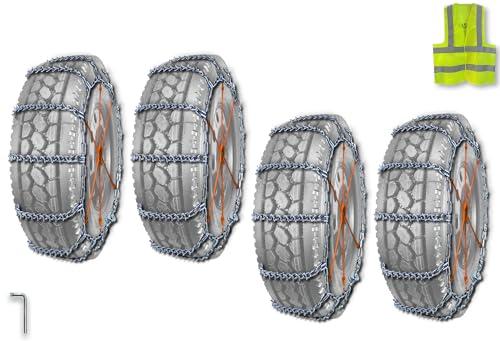
Chains are one of the few purchases where buying the cheaper option can leave you legally unable to move. The number of chains required is set by state law, and it is usually more than two.
The verdict up front
Buy for what your states require, and that is commonly four or more on a tractor-trailer. A single set covers one drive wheel position, which is enough for very few chain-up requirements. Western states with mountain passes typically require chains on multiple positions, and some require chains to be carried aboard during a defined season whether or not conditions demand them. Check the current requirement for every state you run before buying either of these.
At a glance
| Single set | Set of four | |
|---|---|---|
| Wheel positions covered | One | Two axle ends per side or more |
| Meets typical western chain law | Rarely | More often |
| Weight to carry | Manageable | Considerable |
| Storage space | Small | A full side box |
| Cost | Lower | Several times higher |
| Use case | Emergency traction | Actual chain-up compliance |
Choose the single set if
You run lanes where chains are not a legal requirement and you want emergency traction to get off a slick ramp or out of a yard. It is cheaper, lighter and it fits in a side box without displacing everything else. Be clear with yourself that this is a get-unstuck purchase, not a compliance purchase.
Choose the set of four if
You run mountain lanes in winter. When a chain control goes into effect, being short of the required number means you are parked until it lifts, which costs a day and possibly the load. Four chains is heavy and takes real space, and it is what the requirement usually looks like. Practise fitting them somewhere warm before you need them in a gale at altitude.
This is a state law question and it changes
Chain requirements vary by state, by highway, by season and by the control level in effect on the day, and several western states publish specific carry requirements for commercial vehicles over a defined period. Some states also restrict certain chain types. Check the current rule with each state’s department of transportation for the routes you run, and check again each winter, because these do get revised.
Chaining up is the dangerous part
Most chain-related injuries happen while fitting them: kneeling on a shoulder next to moving traffic, in poor light, in the cold, under time pressure. Use a designated chain-up area, wear a hi-vis, put out a light, and take the extra minute. Nothing on the trailer is worth being on the white line for.
These comparisons are drawn from published manufacturer specifications and the general consensus of owner reports. We have not tested these products side by side, and nothing here is legal or compliance advice. Confirm current rules with FMCSA and with the states you run.
Our KOZAK 11R22.5 tire chain review covers what a four-piece set includes, what it leaves out, and why the legal question stays with your state DOT rather than the seller.