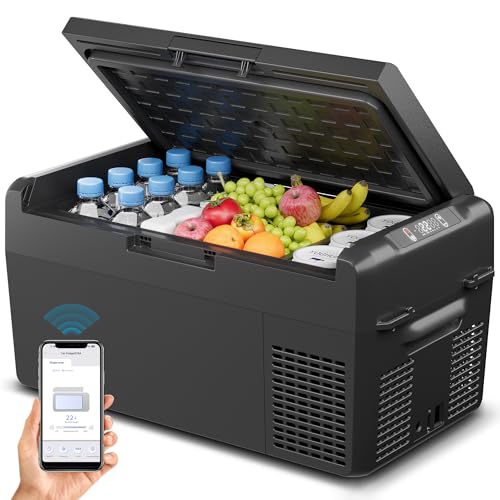
This looks like a price comparison and it is really a food safety comparison, because the two work on completely different principles.
The verdict up front
Buy the compressor fridge. A thermoelectric cooler runs a fixed number of degrees below whatever the cab is, so on a hot afternoon in a parked truck it cannot get food into a safe range no matter how long you leave it. A compressor fridge sets an actual temperature and holds it, exactly like the one at home. The cooler costs less and it is the wrong tool for carrying food you intend to eat.
At a glance
| Compressor fridge | Thermoelectric cooler | |
|---|---|---|
| Holds a set temperature | Yes | No |
| Performance in a hot cab | Unaffected | Degrades badly |
| Can freeze | Yes on many models | No |
| Power draw | Cycles on and off | Runs continuously |
| Noise | Compressor cycles | Constant fan |
| Purchase price | Higher | Lower |
Choose the compressor fridge if
You are carrying food rather than cold drinks. It cycles like a domestic fridge, which means it draws power in bursts rather than continuously, and over a long day parked in the sun it uses less energy than the cooler that is losing the fight. Most have a low voltage cutoff so they stop before flattening the batteries, which is a feature worth checking for.
Choose the thermoelectric cooler if
You want cold drinks on a short run and price is the deciding factor. It is genuinely cheaper and it has no compressor to fail. Be honest about the limitation: on a 95 degree day in a closed cab, a unit that cools 30 to 40 degrees below ambient is sitting well above the temperature at which food is safe, and it draws power the whole time trying.
The food safety line
Perishable food needs to be held at or below 40 degrees Fahrenheit, and the range between 40 and 140 is where bacteria multiply fastest. A parked cab in summer routinely exceeds 120 degrees. That is the whole argument, and it is why the cheaper unit is a drinks cooler rather than a fridge. Carry a small thermometer inside whichever you buy.
These comparisons are drawn from published manufacturer specifications and the general consensus of owner reports. We have not tested these products side by side, and nothing here is legal or compliance advice. Confirm current rules with FMCSA and with the states you run.
Once you have accepted that a compressor unit is the only thing that really holds temperature in a hot cab, our ICECO GO20 review and BougeRV CR30 review cover two of the sizes drivers most often buy.